





HAE SUN HWANG
One of the most compelling aspects of Hwang’s artistic language is her ability to create emotional resonance without imposing a definitive narrative. Her works do not explain what viewers should feel. Instead, they establish conditions in which personal memories and associations can emerge naturally.
HAE SUN HWANG
The Architecture of Attention
Hae Sun Hwang’s artistic practice inhabits the delicate territory between presence and disappearance, where the subtle gestures of everyday life become reflections on memory, time, and human connection.
Through an unmistakably restrained visual language, the South Korean artist transforms seemingly simple images into contemplative experiences, inviting viewers to rediscover the emotional significance of moments that often pass unnoticed.
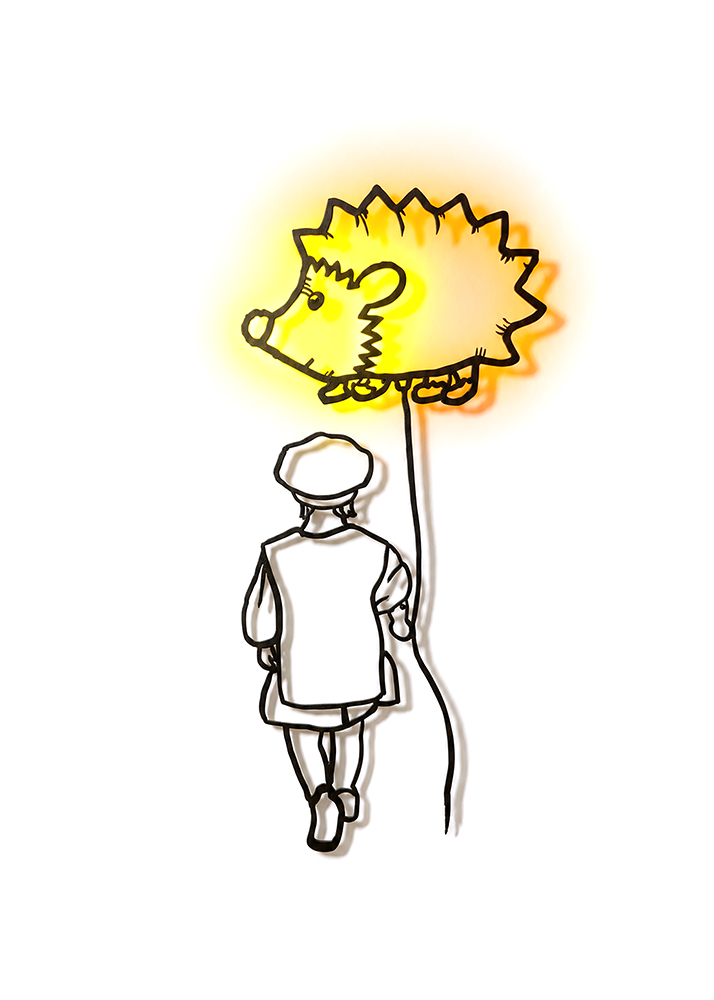
Her figures walk, cycle, stand together, or quietly move away from us. Frequently depicted from behind, without identifiable facial features, they exist beyond individual portraiture. Their anonymity is not an absence of identity but an invitation to identification. A child holding an adult’s hand, a solitary figure beneath an illuminated flower, or two people sharing an ordinary moment become universal images through which viewers may recognise fragments of their own lives.
This relationship between simplicity and emotional complexity lies at the centre of Hwang’s work. Her compositions are defined by an economy of line, carefully considered spatial relationships, and a sensitivity to the expressive possibilities of emptiness. Rather than filling the visual field with information, she allows silence and distance to become active elements of the composition.
Drawing forms the conceptual foundation of her practice, yet Hwang extends its possibilities beyond the conventional surface. Through aluminium structures, pigment, and LED illumination, she translates the intimacy of drawing into sculptural and spatial experiences.
MARCY STONE
Between Turbulence and Stillness
An exploration of gesture, atmosphere, and the shifting boundaries of abstraction
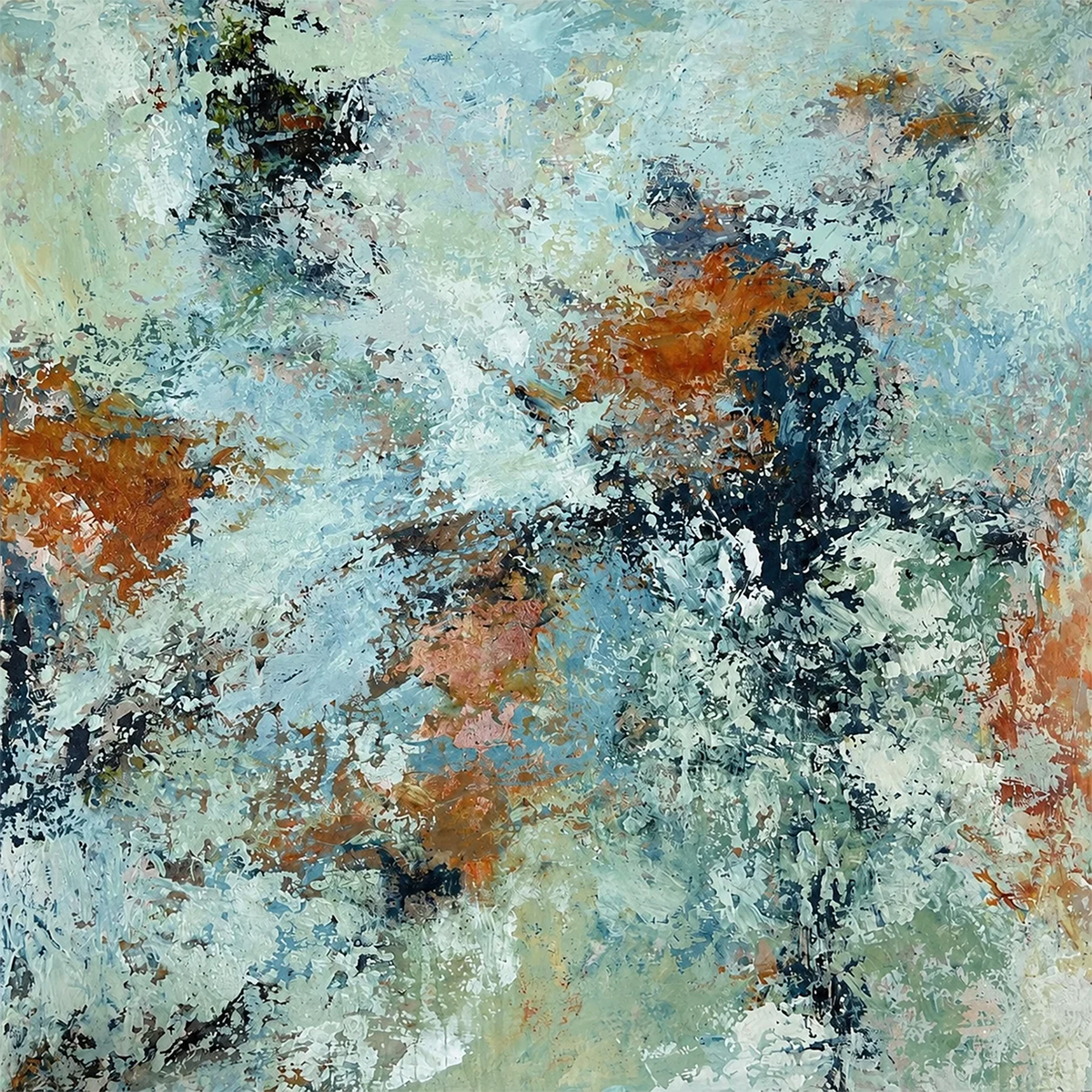
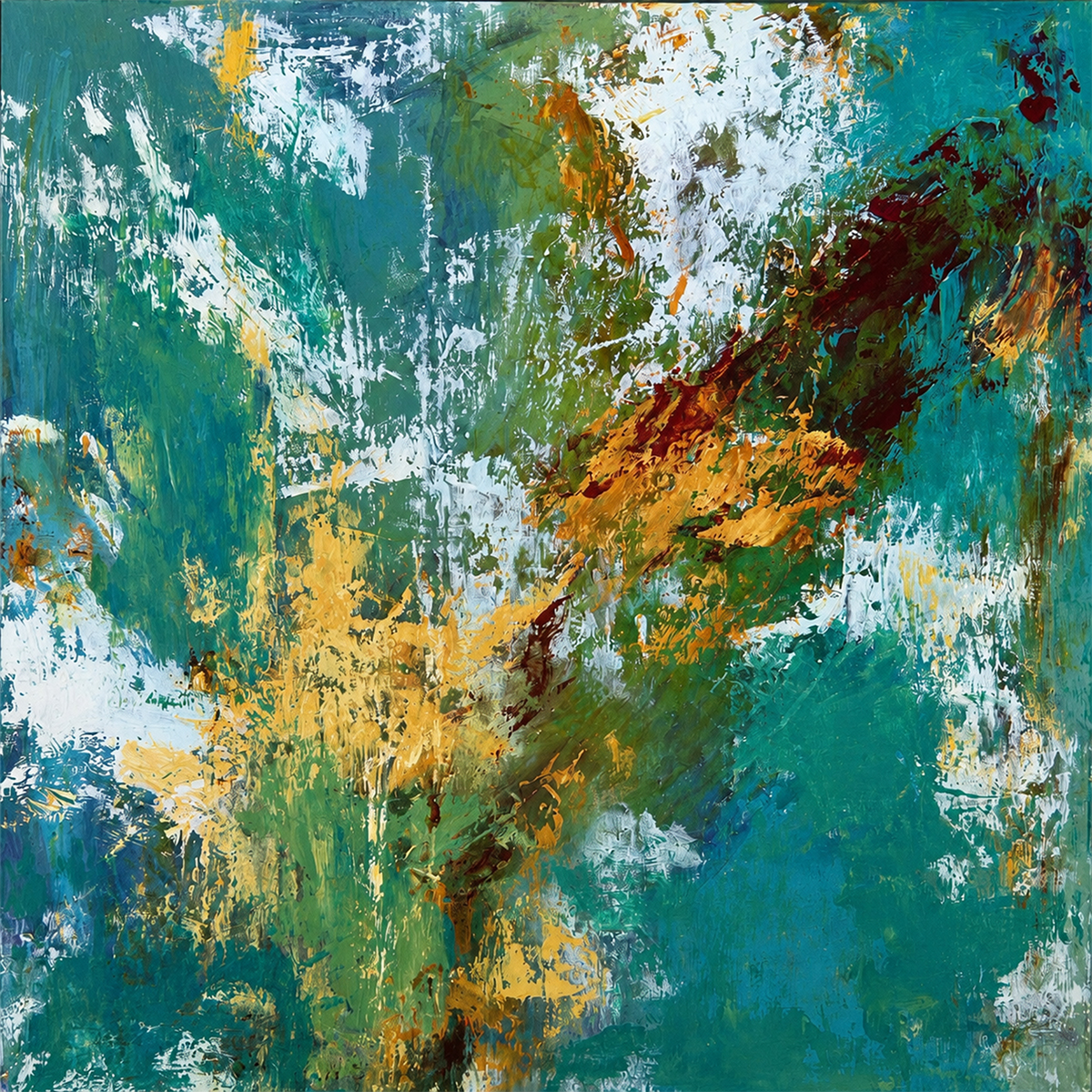
Marcy Stone’s paintings inhabit a compelling territory between atmospheric landscape and gestural abstraction, where colour, movement, and memory converge to create spaces that resist definitive interpretation. Rather than depicting nature, Stone evokes its changing emotional and sensory conditions. Expanses of turquoise, mineral green, and luminous blue suggest water, air, and distant horizons, while passages of rust, ochre, and deep navy introduce moments of disruption, grounding the compositions in a subtle tension between serenity and instability.
At the heart of her visual language lies a continuous negotiation between accumulation and openness. Layers of pigment, fragmented gestures, and irregular textures establish surfaces that seem shaped by time and transformation. Marks emerge, disappear, and reappear beneath translucent veils of colour, suggesting a process in which each intervention both reveals and conceals what came before. The resulting paintings possess an almost geological quality, as though their surfaces preserve traces of successive states of becoming.
Stone’s compositions reveal an intuitive yet deliberate understanding of pictorial rhythm. In her more densely articulated works, vibrant turquoise fields are animated by dispersed gestures that encourage the eye to move freely across the canvas. Elsewhere, concentrated passages of blue and orange introduce a stronger directional energy, cutting through quieter tonal environments. In the more expansive compositions, suspended vertical elements and interrupted horizontal traces evoke reflections, shifting distances, and the possibility of an elusive horizon.
Yet these associations never settle into conventional representation. Stone allows the viewer to recognise fragments of the natural world without imposing a fixed narrative. This ambiguity is central to the experience of her work. Landscape becomes less a subject than a perceptual possibility, emerging through the interaction of colour, gesture, and the viewer’s own visual memory.
CARLA ARDILES
Between Figuration and Expression
The Visual Language of Contemporary Painting
Carla Ardiles’ paintings explore the relationship between figuration and abstraction through compositions in which the human figure, ornamental elements and expressive surfaces coexist. Her work brings together recognizable imagery with an experimental use of colour, texture and pictorial space, creating a visual language that moves between representation and expressive freedom.
The female figure plays a central role in several of her compositions, although its presence takes different forms. In the painting of a dancer, the body becomes the structural focus of the image. Extended arms and an elongated silhouette convey movement, while vibrant red forms appear to expand beyond the contours of the dress. The contrast between the carefully defined anatomy and the energetic background creates a tension between figurative precision and gestural expression.
A more restrained approach emerges in the standing female figure dressed in yellow. Vertical passages of black, grey and ochre reinforce the upright position of the body, establishing a quieter and more balanced composition. The treatment of fabric, skin and flowing hair reveals close attention to anatomical detail, while the surrounding abstract elements introduce a sense of visual ambiguity. The result moves beyond conventional portraiture, allowing the figure to exist within a space that is both recognizable and abstract.
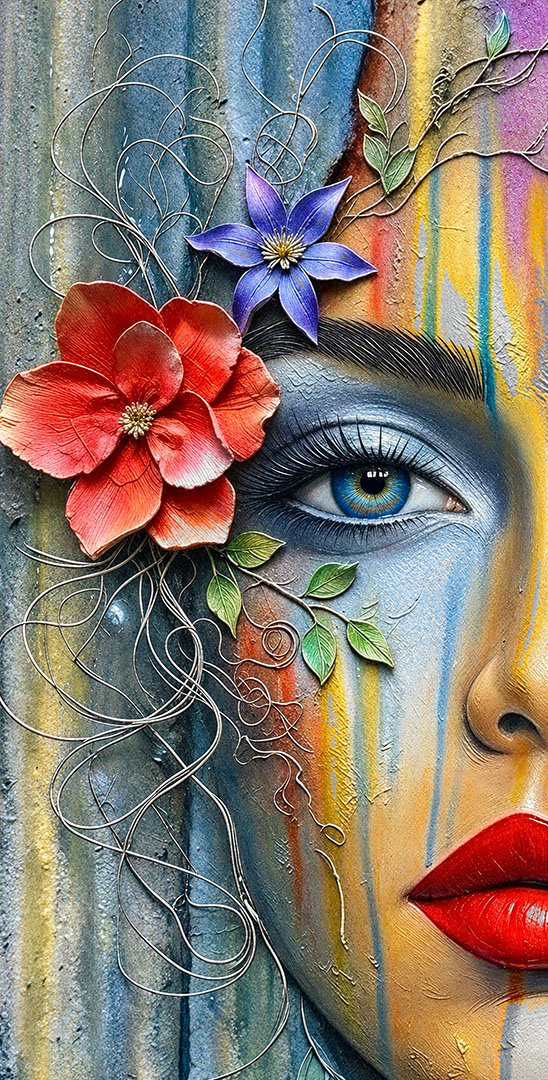
In another composition, the human presence is reduced to a single eye surrounded by sculptural flowers, linear embellishments and saturated colour. Here, the precision of the facial detail contrasts with the complexity of the surrounding ornamentation. The close framing creates an immediate connection with the viewer, while the interplay of organic forms and graphic elements gives the painting a distinctly contemporary character.
SANDEEP SONI
Balance in the Chaos
Between Figuration, Gesture, and the Freedom of Experimentation
Sandeep Soni’s artistic practice unfolds across an unusually diverse visual territory, where figurative painting, expressive portraiture, still life, landscape, and gestural abstraction coexist within a continuous process of exploration. Born in Jodhpur, Rajasthan, and based in Abu Dhabi, Soni approaches painting with a curiosity that resists stylistic confinement. His work is guided by a central philosophy, Balance in the Chaos, reflecting an ongoing negotiation between spontaneity and structure, intuition and control.
This duality becomes particularly compelling when considering his parallel career in engineering and business analytics. While his professional background is rooted in precision and analytical thinking, his paintings frequently embrace uncertainty, allowing gestures, colours, and forms to develop through experimentation rather than predetermined outcomes. The canvas becomes a space where discipline gives way to discovery.
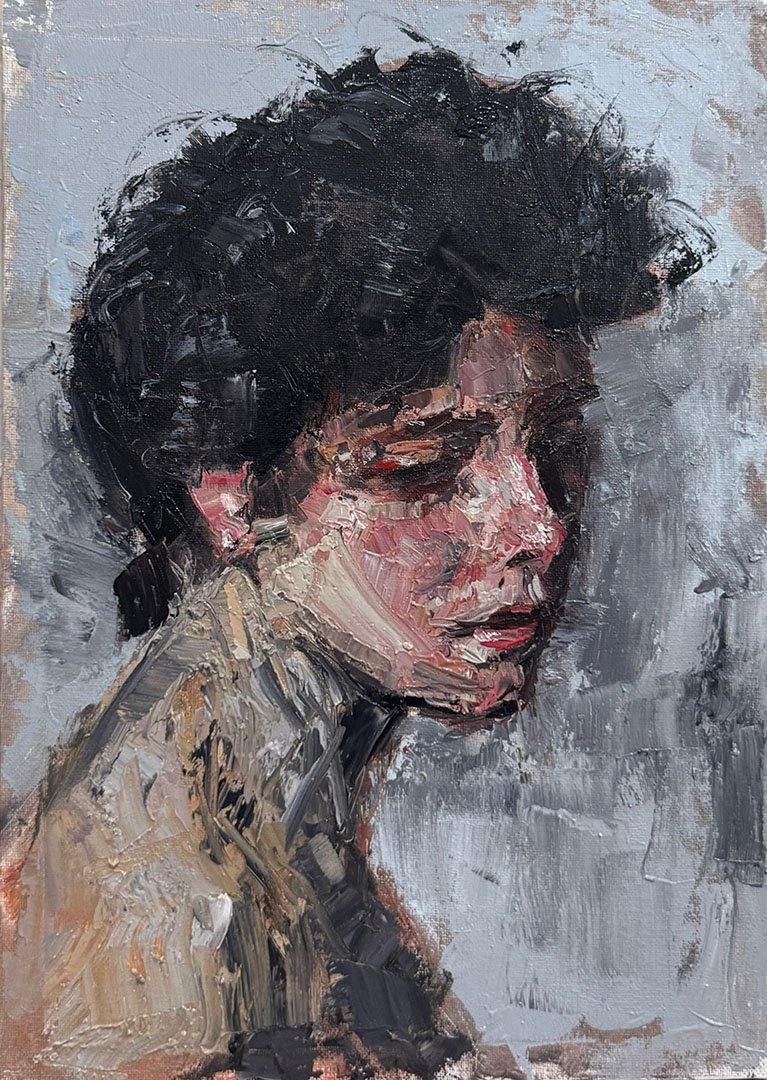
His portraits reveal a sensitivity to the psychological presence of the human figure. Faces emerge through layered brushwork, shifting tonal relationships, and passages of expressive distortion. Rather than pursuing photographic accuracy, Soni explores the emotional possibilities of representation. His figures retain their individuality while remaining visibly shaped by the physical language of painting.
Issue 46 (Art Basel Miami Edition) out now
Featuring
Hae Sun Hwang
Mirela Luebbars
Marcy Stone
Mohamed Hussein
Tara Verkuil
José Luis Ramírez
Carla Ardiles
Graça Tirelli
Tiffany Trenda
Jeanette Seijo
Peter Strid
Michelle Watson
Julia Isabel
Bernat Román
Charly Silva
Formento & Formento
Kerstin Leicher
Will Yaya
Sofía Yaya
Chris Fallows
Claudie Laks
Jean-Michel Lenoir
Alma de Ville
Sandeep Soni
Marina Popovic
Lucía Ravens
Karen G
Alexis Sahr
Marina Yukish
Pérez Art Museum Miami
Crea Ceballos
Marcy Stone
Shinbuk Artist Residency
Louvre Abu Dhabi
Aestara
Jeju Art for Earth
Nicolas Auvray Gallery
The Muisca Gallery